
09 June 2026
Germany’s anti-gas movement is picking up steam
Lützerath. Hambach. Garzweiler. As with the infamous coal infrastructure of the past decade, public opposition against gas plants is growing in Germany. The biggest protest in Europe against a single gas power plant took place on 30 May in Hamm, in the Ruhr region. Organised by Campact, Fridays for Future, BUND, and Greenpeace, thousands of people came out in a heatwave to protest RWE’s new gas unit at Gersteinwerk and called for more investment in renewable energy.
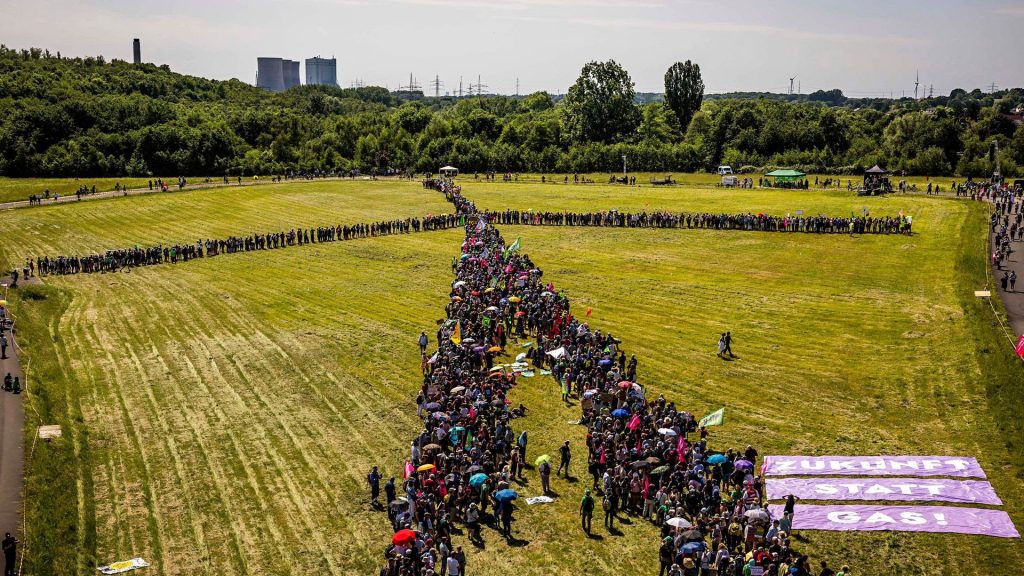
Source: © Lars Berg/Greenpeace
It’s the first time in years that Germany’s climate movement has come together in such large numbers, and with a good reason. The current government has been pursuing gas expansion despite an ongoing fossil fuel crisis that has sent energy bills skyrocketing. Now, opposition to new gas power plants is moving from technical policy debate into public contestation, making visible that new gas is not a technocratic inevitability but a political choice with real consequences for energy bills and fossil dependence.
The Ruhr region is the new gas hotspot
The current design of Germany’s new capacity auctions offers developers 15-year payments for building and operating new power capacity. The first two auctions, in September and December 2026 for 4.5 GW each with delivery between 2031 and 2032, are only open to “long-duration” capacity, thus favouring fossil gas infrastructure. Cleaner flexibility options such as batteries, demand response, and renewables, are excluded.
In North Rhine-Westphalia (NRW) alone, announced gas projects already total 4.6 GW: Voerde 850 MW, Gersteinwerk 800 MW, Hamm 500 MW, Bergkamen 880 MW, Scholven 870 MW, Herne 725 MW. In NRW’s Energy & Heat Strategy however, the state government is explicitly pursuing a flexibility and renewables agenda alongside controversial plans for new hydrogen-capable gas plants.
The scale of the announced Ruhr projects exposes the weakness of the current gas build-out logic. The gas projects listed above amount to around 4.6 GW in NRW alone, roughly equivalent to an entire 4.5 GW federal auction round, even before competing projects elsewhere in Germany are taken into account. With growing political pressure to prioritise new capacity in southern Germany, this makes it highly unlikely that the Ruhr projects can secure support, and underlines the risk that developers are chasing a shrinking and contested subsidy pool. Rather than doubling down on speculative gas projects, RWE and other developers should redirect investment towards renewables, storage, demand-side flexibility and other clean adequacy solutions that NRW’s own strategy already identifies as central to the state’s power future.
Capacity market auctions unfairly favour gas, consumers foot the bill
There is no reason to subsidise additional gas capacity when clean flexibility solutions can provide the necessary adequacy in NRW. The draft federal power plant strategy law acknowledges that the construction of new gas plants to secure electricity supply could cost electricity customers up to EUR 3 billion in 2031, and EUR 0.9-2.3 billion annually from 2032.
Capacity market auctions should not indirectly exclude storage. Since NRW identifies storage and flexible demand as key adequacy tools, the tender design should not automatically pre-select gas power plants. This is especially important given the multi-GW Ruhr gas power projects already announced for upcoming federal tenders. These subsidies will be mostly paid for by households through higher electricity bills, ultimately benefiting private fossil fuel companies while increasing costs for consumers. At the same time, other clean flexibility and renewable-based options are cheaper to build and can deliver adequacy more cost-effectively.
Political will vs public opinion
Since taking office, Economy Minister Katharina Reiche has been pursuing a gas expansion strategy, with a dizzying array of power plant projects that went up to 20 GW of new gas planned and eventually ended up at 10 GW, as negotiated with the EU Commission. The Iran war triggering a major gas crisis hasn’t discouraged the current government from continuing to push for fossil gas. Minister Reiche has previously been vocal about abandoning net zero targets, signing US deals for long-term LNG contracts, and supporting the indefinite installation of gas boilers.
But Germans see things differently. Sixty percent of Germans agreed that the Iran war increased the urgency to speed up the energy transition. Many are beginning to mobilise against gas, not only for climate reasons but also for energy security. Almost 70% of survey respondents agreed that the German government should reduce the country’s dependency on fossil fuel imports by increasing the use of renewable energy and energy storage technologies.
Germany’s gas plant plans simply don’t make sense when more competitive and cleaner solutions are already on the table. As energy bills rise and fossil fuel markets become more volatile, public opposition to gas will only continue to grow. The German government’s capacity market design artificially props up a volatile fuel, serving the interest of profiting private companies while leaving consumers to foot the bill. Instead, public money should go to renewables and clean flexibility, which can truly serve the consumers’ interest by delivering affordable and reliable power.
View this post on Instagram