
COP31: electrification gains ground, but fossil fuels get the last word

By Anna McGurk, Claire Smith and Julia Pazos
For COP31, we were manifesting promises into action. Three years after governments agreed to transition away from fossil fuels at COP28, the world needed a credible plan to make it happen, backed by national roadmaps, finance, renewable energy and the infrastructure to deliver it. With climate breakdown accelerating and the fossil fuel crisis triggered by the US war on Iran, this year was the moment for governments to show how the clean energy transition could tackle these interconnected crises. As UN Secretary-General António Guterres, put it at the COP31 opening ceremony, “fossil fuels must go the way of the dinosaurs. But that will not happen on its own. The dinosaurs did not have a lobby, but fossil fuels do.”
And in the real world ahead of COP, there was growing political momentum. Earlier this year, 57 countries came together in Santa Marta to discuss how to transition away from fossil fuels. Türkiye’s 35 x 35 electrification initiative was originally launched to help accelerate “the shift from direct fossil fuel use to clean electricity across buildings, transport and industry”. And just ahead of COP31, Brazil and the COP30 Presidency published an international roadmap for transitioning away from fossil fuels (TAFF), while a few European governments had advanced national TAFF plans.
However ultimately Türkiye and Australia’s joint COP31 presidency failed to deliver the leadership needed. Despite championing electrification internationally, Türkiye and Australia continued to pursue fossil fuel expansion at home, and they failed to secure a cover decision agreed by all parties. Why? Because countries weren’t happy with the omission of the number one cause of the climate crisis – fossil fuels.
But the failure of the negotiations does not tell the whole story. There was growing international support for TAFF and electrification at COP31, and it’s critical that these agendas continue to accelerate progress in the real world, and are not slowed down and co-opted by fossil fuel interests. From gas companies promoting new power plants as part of electrification, to the AI boom driving additional capacity demand, the question is not simply how quickly the world electrifies, but what powers it, who benefits and whether fossil fuel use actually declines.

The Climate Network crew takes COP31
TAFF- fever spreads at COP
Ahead of COP31 Brazil pushed forward its international roadmap initiative, putting equity, finance and international cooperation at the heart of efforts to turn the historic COP28 commitment into action. Despite it not formally being on the COP agenda, TAFF-fever was spreading. Nearly 100 events on TAFF took place throughout the conference, while more than 20 countries announced national roadmaps. Of those, Finland, Ireland, and Denmark joined Germany, France and the Netherlands in publishing roadmaps, and Spain, Portugal, Switzerland, and Luxembourg announced plans to develop them.
But in the shadow of the roadmaps enthusiasm, lies the very real continued resistance to collective action. The refusal of some governments, including Saudi Arabia, to accept even references to transitioning away from fossil fuels, shows how difficult it is to secure or restate existing political consensus at COP on this issue. Many national roadmaps also do the bare minimum of repackaging existing policies, without new commitments or timelines for phasing out coal, oil and gas. It’s now up to governments to turn this momentum into meaningful action, through the next international TAFF conference, co-hosted by Ireland and Tuvalu, and the second Global Stocktake (GST2), with concrete reductions in fossil fuel use, an end to further expansion, and the finance needed for a fair transition.
Electrification is the star of the show
Electrification was THE buzzword at COP31. Türkiye’s flagship 35-by-35 pledge attracted support from 90 countries, by 18 November, including all 27 EU member states. That’s a lot of political support for getting the world off fossil fuels. Except there’s one big problem: the pledge doesn’t explicitly require electricity to come from renewables or ensure that electrification actually replaces fossil fuels, something that had been raised by +120 civil society organisations. Done right, electrifying our homes, transport and industries with renewables can slash emissions, lower energy bills and free countries from volatile fossil fuel imports. Done wrong, it could give the coal and gas industry a whole new lease of life.
Limiting overshoot of 1.5 °C requires a rapid and substantial decline in fossil fuel use. IRENA shows that achieving the 35-by-35 electrification target in line with 1.5 °C needs at least 78% of global electricity generation to come from renewables. Meanwhile, the IEA finds that coal-fired power has to fall by around 70% and gas-fired power by 60% by 2035. This is why the details of the electrification target matter: without clear safeguards, companies profiting from fossil fuels can present new gas infrastructure as part of the clean energy transition, even as the world urgently needs to reduce its dependence on it.
The COP31 presidencies repeatedly presented electrification as the answer to transitioning away from fossil fuels, without addressing the central question: what would power it? For Türkiye and Australia, two countries heavily dependent on coal, focusing on electrification without clear requirements for clean or renewable power was a convenient way to champion climate action while avoiding more difficult commitments to end fossil fuels dependence.
This tension was palpable during negotiations over the cover decision, as some European governments and Pacific Island countries pushed for explicit links to clean electrification and a reference to transitioning away from fossil fuels in the final text, while others resisted. The divisions exposed how some governments aligned with fossil fuel industry interests are already co-opting the electrification agenda to promote increased electricity without committing to the renewable energy needed to deliver on its promised climate and energy security benefits.
The 35-by-35 electrification target remained in the final proposed cover decision, but ultimately no agreement was reached. Yet the Action Agenda pledge and national commitments to accelerate electrification still stand, as does the scientific case for renewable-powered electrification to limit overshoot of 1.5°C, strengthen energy security and deliver economic benefits.
The 35-by-35 electrification target remained in the final proposed cover decision, but ultimately no agreement was reached. Yet the Action Agenda pledge and national commitments to accelerate electrification still stand, as does the scientific case for renewable-powered electrification to limit overshoot of 1.5°C, strengthen energy security and deliver economic benefits.
The UK and EU were among those championing clean electrification as a way to deliver these benefits. The UK published an electrification roadmap and publicly supported clean electrification over several high level events. “Unlike in the past, there is an alternative to fossil fuels: clean-energy electrification”, said UK’s Foreign Secretary, Ed Miliband in a speech.
Diana Acconcia, head of the EU delegation, assured: “Of course, for the European Union electrification is to be achieved by clean sources of energy.” Yet despite talking up clean electrification, the UK and EU ultimately endorsed a pledge that didn’t require renewable power, which leaves the door open to fossil fuel expansion.
Electrification (fossil fuel lobby’s version)
COP31’s vague electrification target spoon-fed the fossil fuel industry a new business opportunity. We saw this in action with Siemens Energy using the 35% global electrification target to justify more investments in fossil gas use in the power sector to help meet the target.
On Energy Day at COP31, Johannes von Karczewski, Head of Government Affairs at Siemens Energy, said: “This electrification pledge is something different, in comparison to all the other COPs we saw. It’s very concrete, and I think that helps us specifically as industry as well. We put electrification as a core element of our strategy as a company. Siemens Energy is building a lot of the technologies which are needed to electrify, from power generation in wind, to gas power plants, to electrolysers, and so on.” This follows comments from Siemens Energy CEO in August where he spoke about electrification and the rise in total energy demand, particularly from data centres, driving the need for their products.
Siemens Energy, a German energy technology company, is the second largest global manufacturer of gas turbines for gas-fired power plants. Two weeks ago, they announced record profits that are expected to grow to 22% by 2030, with their earnings doubling in the last year due to the surge in demand for gas turbines and grid equipment. Gas turbines and grid equipment for energy-hungry data centres are behind this increase, accounting for nearly 10% of Siemens’ order backlog. In its Q4 presentation to investors, Siemens Energy identifies electrification as a driver of global gas turbine demand through 2035.
Siemens Energy needs to enable a transition away from fossil fuels by ending the expansion of its gas turbine business, stopping the greenwashing of fossil gas for AI data centres, and prioritising investment in wind, grids and storage to deliver renewables-based electrification.
Don’t believe the hype
AI made its big debut on the formal COP agenda, with the launch of the Antalya AI Pledge on November 16th. Backed by only a small number of governments, the pledge is a green light for unchecked AI growth, rather than a serious attempt to rein in its climate impacts. The voluntary pledge does little to challenge the industry’s relentless expansion, failing to require additional renewable electricity or rule out new fossil fuel infrastructure. And the promise that AI itself will help solve the climate crisis deserves scrutiny. A recent study found that 74% of claims about AI’s climate benefits were unproven. As data centres consume ever more energy, COP31 provided a platform for promoting AI as a climate solution, while overlooking the damage caused by the infrastructure behind it.
Simon Stiell, executive secretary of the UNFCCC, warned of AI’s growing costs at the launch of the pledge, calling AI a “double-edged sword” and saying: “We cannot ask people to accept higher bills, more planet-heating pollution, and deeper inequality today, in exchange for promises of a better tomorrow.”
On the same day the AI pledge launched, German state-owned company Uniper unveiled a €6 billion investment strategy covering new gas generation and opportunities to convert former power plant sites into data centres. Yikes! The IEA predicts that global data centre electricity consumption will double by 2030. With associated CO2 emissions rising by 70% as gas and coal generation expand to meet demand, the stakes go well beyond the tech industry.
More demand for electricity will mean more gas plants, greater pressure on grids and higher costs for households. It also represents a massive threat for the clean electrification agenda as big tech’s new data centres will require new electricity that will therefore not be used to electrify other sectors such as transport or heavy industry, delaying even further the fossil fuel phase out. Rather than allowing COP to become a greenwashing platform for Big Tech’s unchecked expansion, governments must ensure that growing AI electricity demand doesn’t come at the expense of renewable, affordable energy for households and industry.
Türkiye fails to deliver
Türkiye’s COP Presidency’s promotion of electrification at COP31 does not reflect its energy policies at home. Just days before the conference, the government unveiled its 2040 Energy Plan, maintaining support for fossil fuels and nuclear energy. On the first day of the Leader’s Summit, President Erdogan announced new oil discoveries in Gabar.
Türkiye’s claims of climate leadership were further undermined by its failure to meaningfully engage civil society and communities affected by the climate crisis throughout COP31. For a presidency promising international cooperation and climate action, the failure to incorporate inclusive and transparent participation exposed more gaps between its words and actions.
As the host country, Türkiye failed to demonstrate strong political will or present a vision for the transformation needed to tackle the climate crisis. Türkiye must start the transition at home and announce a binding, time-bound roadmap for phasing out fossil fuels, starting with coal.
Nilay Vardar, Communications Manager at Beyond Fossil Fuels, said: “COP31, led by Türkiye and Australia, two countries heavily dependent on coal, failed to provide the world with the direction it urgently needs on phasing out fossil fuels. The first message that COP31 President and host Türkiye could have sent to the world was to start the change at home by announcing a just transition away from coal. That opportunity was missed.”
At a time when we are moving towards breaching the critical 1.5°C threshold, the failure to reach consensus on phasing out fossil fuels represents an enormous loss. But we know that the power to drive change comes from collective action, both at the negotiating tables and on the streets. The struggle of civil society will not end until a system in which those who have contributed least to the climate crisis bear its heaviest costs is transformed, and a just phase-out of fossil fuels and climate justice are achieved,” Vardar added.
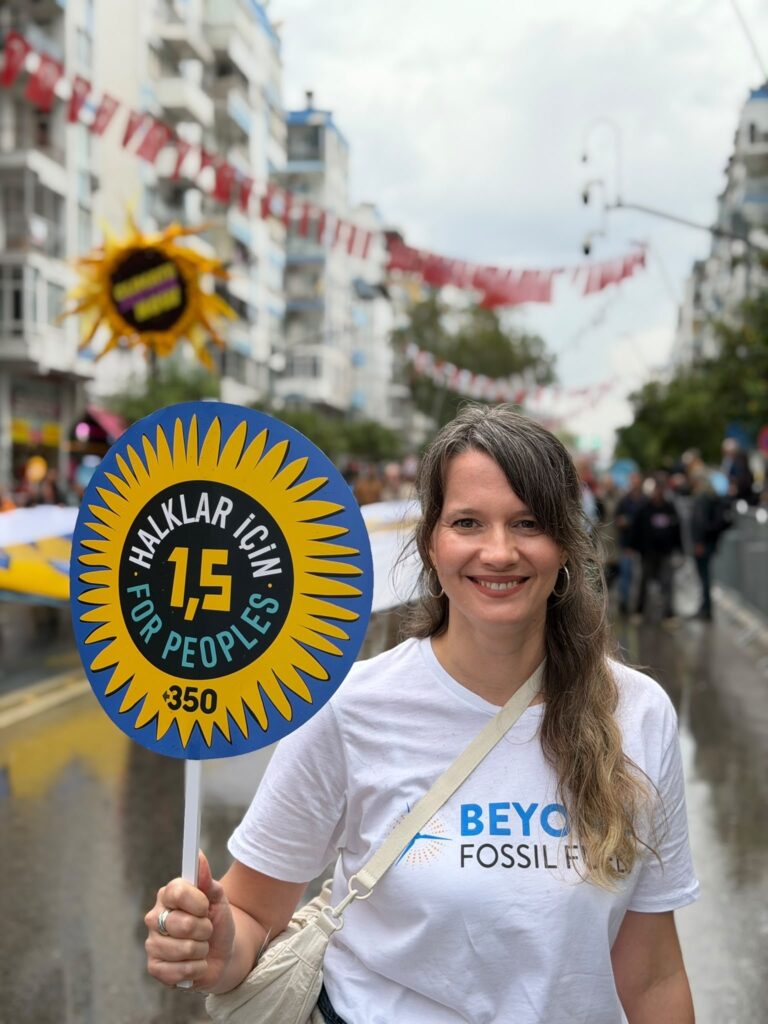
Our comms manager Nilay on the ground in Antalya
What now?
After years of fighting over who would host COP31, the compromise of two presidencies, Türkiye and Australia, ended with no agreed cover decision and a final proposal that didn’t even mention fossil fuels. At a time when the world urgently needs to accelerate the transition away from coal, oil and gas, this failure of political leadership is inexcusable.
But no deal is better than a bad deal. As Ireland’s Climate Minister Daragh O’Brien said, “We will not accept negotiating backwards in time”. While the absence of a cover decision is disappointing, countries were right to hold the line against an agreement that would weaken existing commitments to transition away from fossil fuels and undermine progress towards limiting global warming to 1.5°C.
The failure of the negotiations shouldn’t overshadow the growing momentum for action beyond them. From national fossil fuel transition roadmaps to growing support for clean electrification, more countries are taking steps towards delivering the commitments made at COP28. Last year, the world reached a huge milestone, with renewable energy making up nearly half of the world’s power capacity. Europe is leading the way, as wind and solar generated a record 30% of EU electricity this year, surpassing fossil power for the first time on record. Governments and industry must now turn this momentum into real-world action, accelerating renewable energy deployment, setting credible phase out dates for coal and gas, and securing the finance needed for a just and equitable transition.
As UN Secretary-General António Guterres warned: “The climate crisis will not wait for governments to find common ground. Neither can we.”