
03 December 2018
Citizens Beyond Coal – Christian Doering, Germany
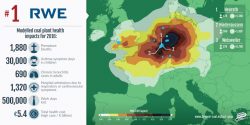
 According to 2016 emissions data from Europe Beyond Coal’s new Last Gasp report on the health impact of coal companies, German energy giant RWE is the worst polluting utility in the European Union.
It has many coal plants, but just four of its lignite plants in North Rhine-Westphalia (Neurath, Niederaußem, Weisweiler & Frimmersdorf) were alone responsible for 65% of RWE’s health impacts, according to modelling. This includes 1,200 premature deaths and €3.4 billion of health costs annually.
These four massive power plants are located close to densely populated areas, with 46 million people living within 200km of them.
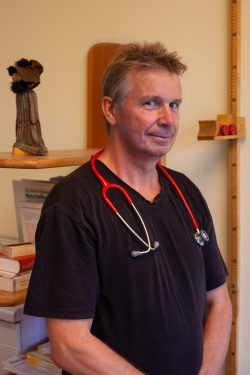
Cologne Paediatrician Christian Doering is one of those exposed to the pollution from these plants, as are many of his patients. He’s concerned about how pollution from RWE coal plants contributes to poor air quality in Cologne, the region, and beyond, as pollutants such as ultrafine particles can travel long distances. He is alarmed on how air pollution can impact the healthy development of children.
 “During pregnancy, even three months before pregnancy, the pollutants inhaled by the mother are decisive, and the new born baby carries a burden of disease throughout its life. As a paediatrician, when I start to work, I’m already at the bottom of the well.”
He says that one consequence of exposure to air pollution can be birth weights dropping below 2,500g, called “birth deficiency”. He adds that premature birth rates also increase. Studies have also shown that lung growth is slower in babies exposed to coal pollution, and their healthy neurological development is threatened.
“Coal soot particles are one of the most poisonous substances that can be found in the air. These ultra-fine particles that penetrate deeply into the body, even during pregnancy, transporting polycyclic aromatic hydrocarbons (PAHs), dioxin-like chemicals, even to the DNA level. They are the stuff paediatricians’ nightmares are made of.”
 “Children who live in Hellental in the Eifel – which has the cleanest air in the Federal Republic of Germany – would need to smoke more than 1.8 cigarettes a day to have the same health burden as the children of Cologne do, due to air pollution.”
Christian Doering stresses the importance of breathing clean air during (and before) pregnancy, air not polluted by particulate matter from coal combustion and other sources, but he can only treat the symptoms to the extent still possible.
“The worrying thing is that the problem starts before we see the children.”
Photography by Greg McNevin