
24 March 2026
Fuelling the fire: more gas means less energy security
By Alexandru Mustață, Coal and Gas Campaigner and Ana Afonso Silva, Data Analyst
Headlines in recent weeks have been singing the same tune: countries that still lean heavily on gas-fired power are the ones left most exposed when global gas supply is shaken. The Iran war has disrupted Qatari LNG and shipping through the Strait of Hormuz, doubling European gas prices and dismantling the old illusion that imported fossil gas equals security again. It’s the biggest price spike since the 2022 energy crisis triggered by the Russian invasion of Ukraine.
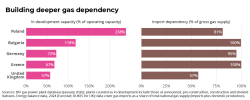
While European countries scramble to provide short-term relief from energy price shocks, many leaders are decidedly not backtracking on gas. What makes this even more absurd is that Europe is not just living with existing gas dependence, but planning more of it. Europe still plans to build 97 GW of new gas plants on the books, with 17 GW under construction already. Germany, Poland, Italy and Greece are some of the main countries pushing for new gas.
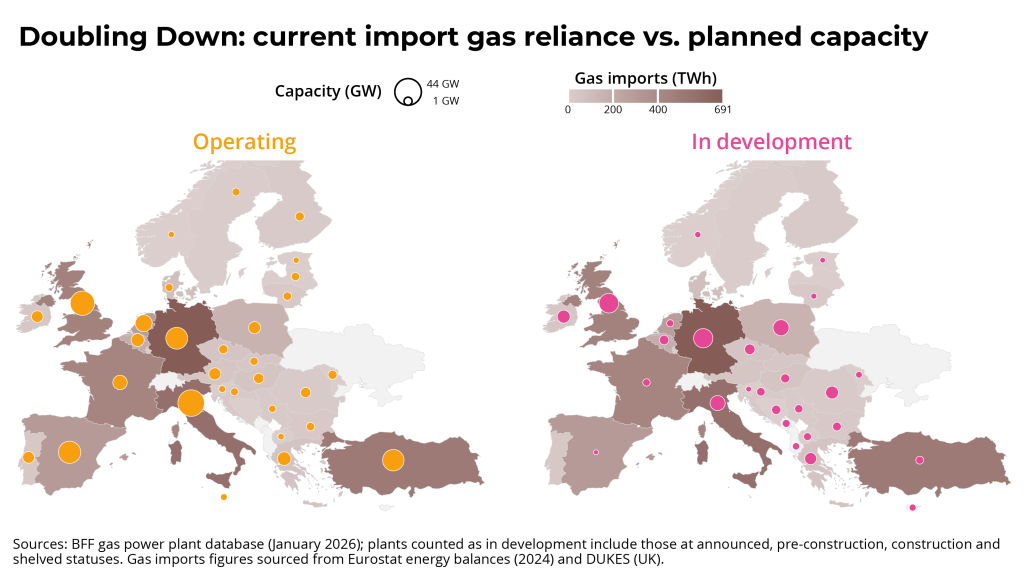
Germany’s gas strategy provides a clear warning. After years of political ping pong, Berlin and Brussels reached a general agreement in January this year for Germany to tender 12 GW of new power from 20 GW, focused largely on gas. Yet the German debate itself has already shown how shaky the case is: earlier plans ballooned, then had to be cut back. The “capacity gaps” that justify the tenders seem inflated because storage, grids, digitalisation and demand-side flexibility are ignored. In other words, even the flagship case for new gas starts to fall apart the moment clean flexibility is taken seriously.
Poland tells a similar story. Despite ending gas imports from Russia after the country attacked its neighbour Ukraine, Poland is still steering towards more gas power plants. Meanwhile, the market is heading in the opposite direction: batteries dominated successive capacity auctions in Poland because they are faster, more flexible and less exposed to volatile fuel costs. This is what real energy security looks like, not another generation of infrastructure that depends on imported gas, public subsidies and wishful thinking about hydrogen or CCS.
One shining light comes from Spain, which so far has better shielded its people from price shocks thanks to years of investment in wind and solar. Ambitious scaling of renewables has reduced the country’s dependence on gas and improved its resilience during times of crisis.
Spain’s Minister for the Environmental Transition, Sara Aagesen recently said “We need to accelerate the reduction of our dependency on imported fossil fuels in favor of homegrown renewable energy.”
Europe should stop using every gas shock as an excuse to build more gas. Trying to fix the problem with more gas is like pouring fuel on the fire and hoping the flames will go out. The lesson from this crisis is the opposite: the way out of fossil insecurity is to reduce dependence on fossil gas. Spain shows that renewables can blunt price spikes. Storage, grids and demand flexibility can do the rest. If governments respond to this moment by doubling down on gas plants, LNG terminals and pipelines, they will not be protecting people nor securing their country from future threats. They will be locking households and businesses into the next crisis before this one is even over.