
08 October 2025
Better oversight, better foresight. Mandating Europe’s energy regulators to think long-term to unlock clean investment.
By
Europe’s clean energy transition depends on modern, efficient electricity grids to unlock its full potential, but outdated regulatory structures and insufficient oversight are slowing down progress. In this paper we propose two urgent reforms for national governments:
- Granting national energy regulators a statutory mandate focused on the energy transition.
- Establishing independent system operators and planners (ISOPs) to oversee grid planning and operation.
These reforms would align regulatory decisions with long-term climate goals, reduce investment barriers and improve system efficiency, paving the way for a secure, affordable and resilient energy future.
The grid: Europe’s strategic asset for energy security and competitiveness
Electricity grid upgrades will be central to Europe’s future energy security and competitiveness. Greater grid capacity and faster connections will accelerate electrification and the deployment of homegrown renewables, and allow Europe to reduce dependence on volatile energy imports. A more flexible and electrified industry will reap the benefits of greater efficiency and lower long-term prices, allowing the EU to lead in key clean tech markets. A great prize is in reach: robust management of the decarbonising electricity grid will result in energy abundance, energy resilience, and energy affordability.
It is clear that Europe needs to build out grid infrastructure faster, and use its existing grids more effectively. Without action, grid connection bottlenecks will continue to delay the roll-out of renewables and the future-proofing of key industries. As highly regulated entities, Europe’s grid operators need clear signals and independent oversight to ensure they are planning, investing and operating networks in a way which is fit for the future. Yet, at present, many grid operators are heading into the future with tools from the past. Independent oversight and transparency regarding their planning and investment is generally insufficient.
More robust, fully independent system planning can help ensure value for money and effective delivery. National legislators urgently need to act on two points to ensure that climate goals as well as integrated planning and operation are properly in place.
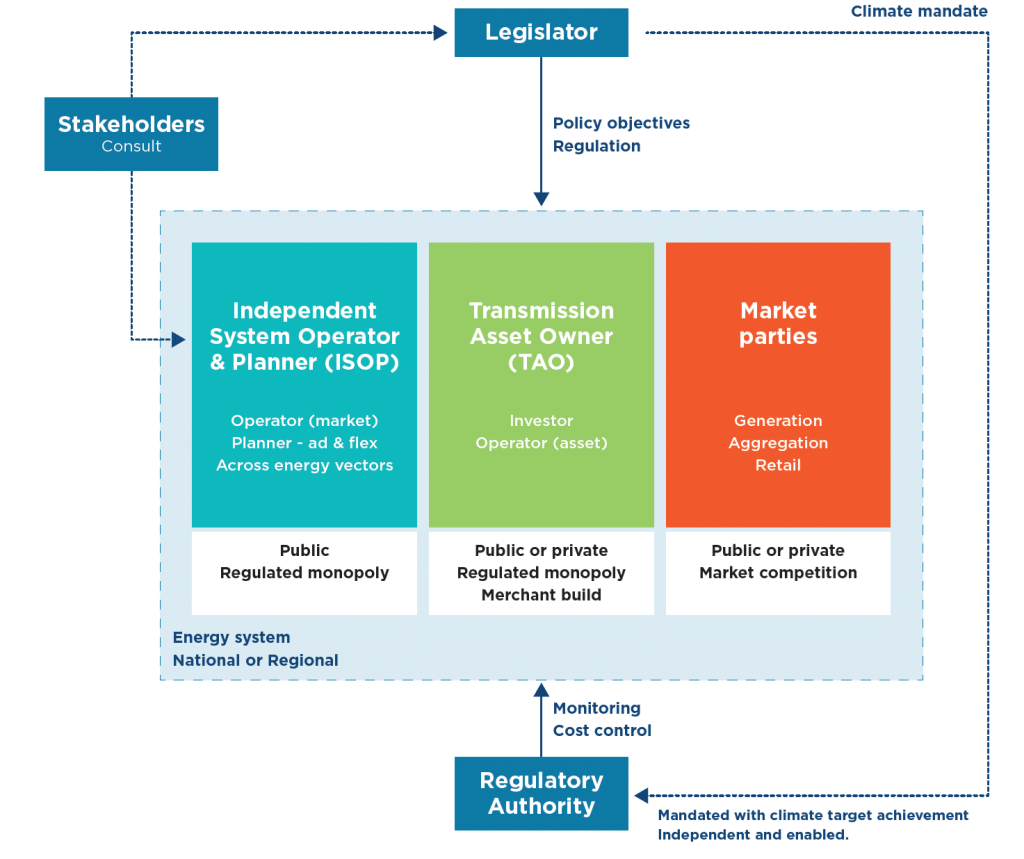
- Provide the national regulatory authority (NRA) with a statutory mandate for the energy transition in the public interest encompassing electrification, affordability, energy security and climate action. Current NRA mandates are too narrow; or they are too focused on the short term, conflicting with long-term climate action. The exact emphasis can be different depending on national contexts. This mandate should allow the NRA to make decisions and take actions which are meaningfully long-term, and can help unlock investment in the clean economy.
- Establish a new public body, an independent system operator and planner (ISOP), to draw up integrated grid plans and oversee the daily functioning of the grid and energy markets. An ISOP will be better able to plan across electricity, district heating and the remaining molecule pipelines, both inside and across borders. This will lead to better investment decisions for the grid users of today and tomorrow.
Reform 1: Give regulators a statutory mandate for energy transition in the public interest
Regulators currently have to judge and balance many societal priorities, not solely reliability and costs. A clean energy transition mandate brings the regulator in line with governments’ legal climate obligations and directly links consumers’ interests to specific climate goals. It helps to overcome the precedence of short-term duties and concerns.
This mandate allows the regulator to make decisions and take actions with a genuinely long-term view, and can help unlock efficient investment in the clean economy, providing clarity where there are competing duties which can be seen to conflict with long-term action.
A mandate for the energy transition can also underpin other governance features, such as the ISOP. It could facilitate the translation of National Energy and Climate Plans’ trajectories into the development of a ‘net-zero grid’, supporting the reduction of connection queues holding back investment in renewables.
| Case study: Ofgem net-zero duty
Ofgem is Great Britain’s statutory energy regulator. In 2023, the UK’s Conservative government amended the existing duties of the Gas and Electricity Markets Authority (the governing body of Ofgem) by including reference to the net-zero targets. This update meant that Ofgem now has a duty to consider, as part of the everyday decisions it makes, how these may assist in meeting the UK’s net-zero targets and carbon budgets. This move was widely welcomed by a cross-section of society, from industry to consumer rights groups. Trade body RenewableUK said the duty was “essential to change how we prioritise building vital new infrastructure to connect clean energy projects to the grid” and suggested it could unlock at least £15 billion of investment in offshore wind by the end of the decade. Energy UK similarly concluded that the net-zero duty could result in a more strategic approach in delivering our energy infrastructure and enable anticipatory investment, “helping address the significant backlog of projects unable to connect to the grid and enabling more consumers and businesses to decarbonise when they wish to”. |
Reform 2: Establish an independent system operator and planner
‘Unbundling’ is the separation of energy supply and generation from the operation of networks. If a single company operates a transmission network and also generates or sells energy, it may have an incentive to obstruct competitors’ access to infrastructure. This prevents fair competition in the market and can lead to higher prices for consumers. European regulation therefore requires unbundling, but the results vary across countries.
Originally, in many countries single companies managed the whole electricity value chain, from production over distribution to supply. This made it hard for new players, like decentralised renewable energy providers, or resulted in opaque and excessive energy costs. Over time, power plant owners, grid companies and retailers were unbundled, creating room for innovation and new entrants.
Today, many grid operators still own the infrastructure, keep the grid in balance and plan its development. It’s crucial to untangle those functions, especially where they are currently in the remit of commercial entities. If this doesn’t happen, the solution for every grid problem will be to build more wires, while demand-side flexibility, storage and community energy projects remain underutilised. This happens because grid companies often earn more from capital investments (CAPEX) than from operating costs (OPEX). Regulation tends to reward CAPEX more, and the physical assets also make up a much larger share of the grid companies’ turnover.
The next step is to create independent system operators and planners (ISOPs), public bodies that plan and run the grid without owning it. This model was recently adopted in Great Britain, where the National Energy System Operator (NESO) was formed as a public entity separate from National Grid, the company owning the grid. Creating an ISOP is not required yet, only made possible in the European regulatory framework.
A fully independent system operator and planner model is a structural solution that remedies the problem at the root, ensuring the grid build-out is in line with public – rather than private – interests. Especially in a time when whole-system planning across energy carriers and neutral expert advice to governments are needed, an ISOP will play a crucial role. The independent system operator should be subject to economic incentives that support cost-efficient operation of the existing infrastructure. The ISOP can then take better and more neutral decisions, aligned with the public and climate interest.
Figure – Grid governance schematic
RAP and Beyond Fossil Fuels background materials
- Regulation to guide anticipatory investment: https://blueprint.raponline.org/deep-dive/revitalising-regulation-to-guide-anticipatory-investment/
- Empowering regulators to advance decarbonisation: https://www.raponline.org/knowledge-center/pathways-empowering-regulators-advance-decarbonisation/
- How Europe’s grid operators are preparing for the energy transition: A snapshot of electricity transmission system operator practices and plans: https://beyondfossilfuels.org/2025/05/13/how-europes-grid-operators-are-preparing-for-the-energy-transition-a-snapshot-of-electricity-transmission-system-operator-practices-and-plans/