
26 May 2026
Europe’s dash for new gas plants is built on shaky maths: New research shows how Poland could avoid up to 20 GW of gas
Authors: Kuba Gogolewski, Programme Director at Mission Possible and Juliet Phillips, Energy Campaigner at Beyond Fossil Fuels
As Europe grapples with another fossil fuel price shock, the dangers of relying on imported gas and oil are once again impossible to ignore. The European Commission itself has acknowledged that the only path to lasting energy security is to get off volatile fossil fuels and ramp up investments in homegrown clean energy; which is the foundation for a more electrified, resilient and affordable economy.
However, at present, many European governments are still pushing ahead with plans to expand their gas plant fleet – risking decades of further price shocks and fossil fuel dependence. Research from Beyond Fossil Fuels found that European countries are currently planning to build nearly 100 GW of new gas plants.
This is due to a prevailing fallacy that gas plants are the only viable option to ensure the energy system is reliable and can support increasing electricity demand. Unsurprisingly, this position is pushed by the fossil fuel and nuclear industries, who benefit greatly from overestimating future electricity demand. These views are often reinforced by modelling and analysis undertaken by national Transmission System Operators (TSOs), energy regulators and government departments. In turn, these important estimates are used to inform subsidies such as capacity markets, which have greatly benefited gas plants to date in the 6 countries where they have been introduced.
This is particularly concerning because many gas plants are designed to run most of the time and operate as baseload units. In practice in Poland, this means that they would end up replacing coal-fired power plants and limiting the space for cheaper clean energy in the electricity system.
But what if this modelling and analysis contains an inherent bias towards big centralised energy generation, leading to more planned gas and nuclear power capacity than our societies and economies actually need– and an alternative, more energy secure future is possible?
New research by PhD Krzysztof Bodzek Silesian University of Technology shows that Poland could avoid the need for investments in generation equivalent up to 20.8 GW of gas plants by 2040, compared to a business as usual scenario. If local renewables, storage, demand-side flexibility and local balancing are properly developed, a significant part of future electricity demand could be supplied and consumed locally – rather than via large central power plants such as gas or nuclear.
The research shows how this “gas and nuclear bias” is the result of data blind spots in the modelling of PSE – the Polish TSO, the Polish government and the Polish National Energy Agency modelling.
A key factor is that the boom in Polish self-consumption is almost completely overlooked. Self-consumption is the production and immediate use of energy with the growing role of renewable energy—usually solar power—at the site of generation, such as homes, public institutions or businesses.
Self-consumption has significantly increased in Poland. Between 2021 and 2025, the number of prosumers increased from 0.85 million to 1.61 million, and estimated prosumer auto-consumption increased from approximately 0.9 to 3.1 TWh. These numbers are expected to continue to grow into the future. Yet, at present, they are not being factored into the modelling and analysis which is underpinning the country’s energy plans.
Another core assumption which the research challenges is that the speed at which the Polish economy grows is directly correlated with the growth of electricity demand. Over the last three decades, Poland’s Gross Domestic Product (GDP) has increased much faster than electricity consumption. The impact of strong Polish GDP growth on electricity demand has significantly weakened especially since 2021. This means that future electricity demand should not be projected mechanically from GDP growth and patterns from the past cannot be projected into the future to inform future electricity demand.
For example, the modelling of the Polish TSO, PSE, assumes a major increase in national electricity use; with projections that the country’s year-on-year use would leap by an enormous 11 TWh this year – something which is not set to happen.
The main planning risk is that Poland may overestimate the volume of electricity that will have to be supplied by large-scale centralised generation. If self-consumption and local balancing are not properly included in official modelling, this may lead to excessive investment in central generation and transmission grid infrastructure. The problem is not only overbuilding capacity, but also creating infrastructure and assets with low utilisation, high system costs and potential stranded-cost.
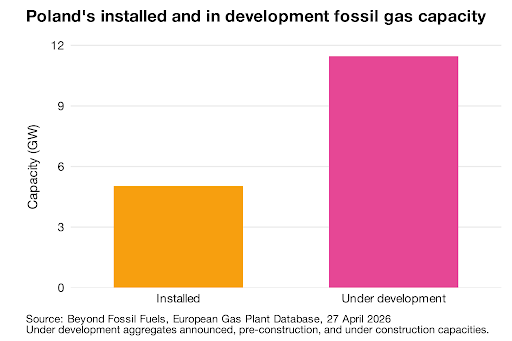
The study serves as an important reminder that there is more than one possible future for Poland, which currently has 5 GW of gas plant capacity, and is currently working on plans to build out a further 11.5 GW of plants.
The research should prompt a fundamental rethink of the country’s capacity market – which has been overhauled by the TSO and government to ensure it benefits expensive gas plants over batteries.
A new approach is needed for the planning and operation of Poland’s electricity grid. Future improvements in Poland’s energy balance will depend not only on the construction of new sources, but also on limiting losses and reducing the energy consumed by the system itself. Additional effort is needed to use the already high and quickly growing PV generation more efficiently; prioritising electrification of the heating and transport sectors in areas where renewable energy curtailment is biggest.
The need for a fresh approach to understanding the energy system does not just apply to Poland. Across Europe, there is a need for new ways of planning and investing in our energy systems to end our reliance on risky gas; and instead support renewables, clean flexibility solutions as well as the modernisation of our electricity grids.
This is also what the European Commission recommends, advising Member States to “develop a national strategy for energy communities and self-consumption, including an assessment of the potential contribution to EU energy objectives by 2030 and 2040 based on an assessment of the potential and barriers […] and report progress through the integrated progress reports on the national energy and climate plans”.
The current fossil fuel crisis since the war on Iran started is a cry for change. Europe’s energy security and economy depend on permanently decoupling our energy systems from fossil fuels. The good news is that a more secure energy future is actually possible for Poland – enabling millions of households to share in the benefits of cheaper, homegrown renewable energy. The responsibility now falls on Europe’s energy ministers, TSOs and regulators to ensure we are planning and building out our energy systems to avoid massive – and unnecessary – investments in excessive large-scale generation capacity, such as fossil gas power plants.